
This is the full conference schedule for the National Student Government Summit. The National Student Government Summit is a four-day conference featuring 46 workshop sessions, including several led by student leaders & advisors, 8 round-table networking caucuses, 5 private consulting appointments, and more than 24 information-packed hours of practical help, ideas, and advice on how to improve your SGA.

2027 Conference Schedule
▶ Wednesday, October 6, 2027
Lobbying on Capitol Hill (OPTIONAL)
-
Visits to U.S. House of Representatives members and U.S. Senators (on your own)
- Visits to monuments and museums (on your own)
▶ Thursday, October 7, 2027
Conference Attire • Thursday — Business
See the meeting room floor plan
8:00 a.m. to 5:00 p.m. — Lobbying on Capitol Hill (OPTIONAL)
- Visits to U.S. House of Representatives members and U.S. Senators (on your own)
- Visits to monuments and museums (on your own)
6:00 p.m. to 10:15 p.m. — SG Exchange
(Bring your SG brochures, constitutions, & swag to swap with attendees)
Lexington
6:00 p.m. to 7:30 p.m. — Conference Registration & Networking
- Dinner (on your own) See ASGA’s restaurant recommendations and discounts
- Visits to Conference Exhibitor Booths
Hall of Battles
7:30 p.m. to 8:30 p.m. — Conference Kick-Off
(Doors open at 7:00 p.m. Arrive early to get the best seats)
- Christopher C. Irving, Ed.D., Emcee
Regency B/C/D (Ballroom)
8:30 p.m. to 8:45 p.m. — Networking Break
8:45 p.m. to 9:45 p.m. — FOR ADVISORS “ASGA Loves Advisors” Reception
- W.H. “Butch” Oxendine, Jr., Host
- Raffle
Thornton Room (11th Floor)
8:45 p.m. to 9:45 p.m. — Training/Roundtable Block 1
(Tell ASGA what you want to learn about: Take this survey)
- ROUNDTABLE: Community Colleges (Suzette Walden Cole, Ph.D., facilitator)
Regency B (Ballroom) - ROUNDTABLE: Private Colleges & Universities (Andrew Ortiz, J.D. facilitator)
Regency C/D (Ballroom) - ROUNDTABLE: Public Colleges & Universities (Christopher C. Irving, Ed.D., facilitator)
Columbia A/B - ROUNDTABLE: Super-Evolved Student Governments (Butch Oxendine, facilitator)
Columbia C - Private Consulting (Butch Oxendine)
Lexington
9:45 p.m. — Free for Evening
Suggested Night-Life Activities
Late Dinner on the Town: Find out where to eat and see ASGA’s restaurant recommendations and discounts
▶ Friday, October 8, 2027
See the meeting room floor plan
6:00 a.m. to 8:30 a.m. — Lobbying on Capitol Hill (OPTIONAL)
8:00 a.m. to 6:00 p.m. — SG Exchange
(Bring your SG brochures, constitutions, & swag to swap with attendees)
Lexington
9:00 a.m. to 10:00 a.m. — Training/Roundtable Block 2
(Tell ASGA what you want to learn about: Take this survey)
-
 A FOR ADVISORS Keeping HOPE Alive: How to Sustain & Grow Your Student Leaders – Christopher C. Irving, Ed.D.
Regency B (Ballroom)This interactive workshop will explore the different skills needed for SGA advisors to recruit, retain, and train their student leaders. Participants will engage with other advisors to create a framework for training and assessing student involvement and growth. Once the framework has been examined, the presenter will share activities and experiences participants can use to empower their student leaders.
Learning Outcomes. After attending this session, participants should be able to:
- Content knowledge regarding leadership theory, as well as the applicable terminology
- Understanding of creating assessment models and tools for student development
- Participation in experiential activities that enhance self-knowledge, team-building and leadership awareness
-
 B How You Can Connect With Students: Survey Them! – Butch Oxendine
Regency C/D (Ballroom)When you tackle an issue, you must be certain that students want and need you to work on that project. Your SG can’t rely on word of mouth, a handful of private conversations, or the few responses you get from a survey at a table in the cafeteria. Surveying in person is the ultimate way to spread the word about your SG and connect with your peers on a daily and personal level that they have never seen before from your SG. You can’t expect students to come to your SG with their concerns. You must go to them!
Delivery Format: This workshop is presented in a lecture format. Half of the workshop, however, is an interactive exercise that includes all participants. The presenter welcomes and encourages feedback through direct questions throughout.
Presentation Resources: The session utilizes Microsoft PowerPoint, as well as printed handouts.
Level of Interactivity (from 1 to 5, five being very interactive): 5
Learning Outcomes. After attending this session, participants should be able to:
- Understand how surveying can transform your Student Government
- Know what questions to ask, when to ask them, and who to ask
- Know how to gather and analyze the results and use them to initiate changes
-
C The Engagement Playbook: Strategies for Student Leaders – Suzette Walden Cole, Ph.D.
Columbia AStudents aren’t indifferent—they’re waiting for the right spark. As a student leader, your role is to turn passive bystanders into active participants in campus life. This session explores how to recognize barriers that look like apathy, unlock the “Power of One,” and use practical strategies to mobilize peers, build connection, and ignite lasting engagement across your campus.
Delivery Format: This workshop utilizes a balance of engaging lecture format and interactive activities that are designed to unpack the process to practice, thought-provoking and oriented toward skill-building.
Presentation Resources: The session utilizes visual display media (i.e. Microsoft PowerPoint, PollEverywhere, video) and printed handouts.
Level of Interactivity (from 1 to 5, five being very interactive): 4
Learning Outcomes. After attending this session, participants should be able to:
- Distinguish true indifference from barriers like overwhelm, disconnection, or lack of awareness
- Discover how small, intentional actions by a single leader can inspire peers, build momentum, and create ripple effects across campus involvement
- Gain practical strategies to mobilize students—from personal outreach to creative programming—that foster belonging and drive sustained participation
-
 D Who Cares? Transforming Apathy Into Action – Andrew Ortiz, J.D.
Columbia BIt is a primary goal of most effective Student Governments to mobilize their student body to participate actively in events, elections, and projects, and to truly care about their school. This workshop will provide ideas for putting the “pathos” (or feeling) back into your student body by giving them tangible reasons to care.
Delivery Format: Due to the significant amount of technical information provided in this session, it is presented in a lecture format. The presenter welcomes and encourages feedback through direct questions to the audience as well as fielding impromptu questions throughout.
Presentation Resources: The session utilizes visual display media (i.e. Microsoft PowerPoint) as well as printed handouts.
Level of Interactivity (from 1 to 5, five being very interactive): 3
Learning Outcomes. After attending this session, participants should be able to:
- Discuss the reasons why students often don’t care about Student Government
- Share some tangible ideas for mobilizing and engaging the student body on your campus
- Learn how to create a culture of participation within your SGA
-
 E Who Said There’s No “I” in Team? – Vicky Goodin, Ed.D.
Columbia CYou are only as strong as your weakest link. The more you understand about the various personalities in your organization the more successful you will be. While there may be no “I” in team, understanding yourself can be the key to your success in SGA! Participants will take a personality inventory that will help them understand how they operate in a team and how to use that information to build a better SGA.
Delivery Format: This workshop utilizes a balance of engaging lecture format and individual and small group interactive activities that are self-reflective, thought-provoking and oriented toward skill-building.
Presentation Resources: The session utilizes visual display media (i.e. Microsoft PowerPoint), as well as printed handouts.
Level of Interactivity (from 1 to 5, five being very interactive): 4
Learning Outcomes. After attending this session, participants should be able to:
- Assess individual personality type
- Understand how individuals work in teams
- Understand how to utilize the assessment to create a better team environment
-
Advisor Work/Quiet Space
Bunker Hill - Student Leader Work/Quiet Space
Lexington
10:00 a.m. to 10:15 a.m. — Networking Break
10:15 a.m. to 11:30 a.m. — Training/Roundtable Block 3
(Tell ASGA what you want to learn about: Take this survey)
-
 F SG Training With an “Attitude” – Christopher C. Irving, Ed.D.
Regency B (Ballroom)This workshop is designed for student leaders to develop a repertoire of techniques and skills for creating an effective and supportive team during SG training. Participants will build skills in self-awareness, communication, problem-solving, and empathy through group discussions and unique activities. SG organizations benefit as leaders apply turnkey activities that invite their membership to gain greater self- and interpersonal awareness, understanding, and skills.
Delivery Format: This workshop utilizes interactive activities that are thought provoking and skills based. Most of the time participants will feel like they are playing fun and interesting games in this session only to be hit with the “ah ha” moment at the end.
Presentation Resources: This workshop utilizes the participants through interactive experiences.
Level of Interactivity (from 1 to 5, five being very interactive): 5
Learning Outcomes. After attending this session, participants should be able to:
- Understand the value of SG trainings and their place in goal setting
- Learn critical elements for creating and sustaining a strong team
- Create a unified foundation for “success” for all members of your SG
-
G Your SGA Report Card: 13 Steps to Raise Your Grade to A+ – Butch Oxendine
Regency C/D (Ballroom)Are you the best SG in America? Before you start boasting, even the finest SGs have lots of room for improvement. And just because you control millions in student fees and get quoted in the campus paper doesn’t mean that you’re truly appreciated, respected, and actually get things done for your fellow students. The nation’s “Super SGs” have some key characteristics in common. This is your chance to finally find out how yours stacks up against the best. By taking ASGA’s “SG Effectiveness Test,” you’ll learn about your strengths and weaknesses and will get guidance on setting priorities and realistic goals to improve your SG now.
Delivery Format: Lecture style because of the amount of information provided. The presenter encourages feedback through direct questions throughout.
Level of Interactivity (from 1 to 5, five being very interactive): 3
Learning Outcomes. After attending this session, participants should be able to:
- Understand the 13 key components that make up great SGs
- Know what to do first to improve
- Understand your SG’s current strengths and weaknesses
-
 H Knowing When and How to Call Someone Out: Confronting Members Within the SG – Suzette Walden Cole, Ph.D.
Columbia AConfronting members on issues, behaviors, and other performance related matters can make for challenging situations for all of the parties involved. In this session, we will explore confrontation techniques, ways to proactively prevent confrontation with negative results, tips on minimizing the impact to the SG, and recommendations for the post-confrontation follow-up.
Delivery Format: This workshop utilizes a balance of engaging lecture format and interactive activities that are self-reflective, thought-provoking and oriented toward skill-building.
Presentation Resources: The session utilizes visual display media (i.e. Microsoft PowerPoint, video), as well as printed handouts.
Level of Interactivity (from 1 to 5, five being very interactive): 4
Learning Outcomes. After attending this session, participants should be able to:
- Provide a basic self-reflective understanding of their triggers for conflicts
- Gain content knowledge of techniques to engage in confrontations
- Recognize when it is necessary for officer or advisor intervention
-
I We’re In This Together: Representing All Students On Your Campus – Andrew Ortiz, J.D.
Columbia BHow can your Student Government provide a “big tent” that all campus entities feel comfortable and proud to become affiliated with? Like most successful organizations, it’s largely about building relationships. In this workshop, you will learn new ways to connect with campus clubs and organizations and make Student Government a center of action and diversity. Your campus is full of talented, interesting, and promising leaders and organizations, but, as with any treasure, you need to continually seek them out and uncover new sources. Andy Ortiz will provide the tools to support these efforts.
Delivery Format: Due to the significant amount of technical information provided in this session, it is presented in a lecture format. The presenter welcomes and encourages feedback through direct questions to the audience as well as fielding impromptu questions throughout.
Presentation Resources: The session utilizes visual display media (i.e. Microsoft PowerPoint) as well as printed handouts.
Level of Interactivity (from 1 to 5, five being very interactive): 3
Learning Outcomes. After attending this session, participants should be able to:
- Develop a strong understanding of the diverse constituencies on your campus
- Learn from best practices on how to approach and engage various interest groups/stakeholders
- Develop strong and trusting relationships with other key individuals/groups that will enhance the relevancy of your SGA
-
 J Mission SGA! – Vicky Goodin, Ed.D.
Columbia CBe a change leader at your school. Make things happen! The key to a successful SGA is having a strong mission and solid goals. Participants will be inspired to become change agents in SGA and create the mission statements for their organizations…taking them on the road to a successful and purposeful year.
Delivery Format: This workshop utilizes a balance of engaging lecture format and interactive small group activities that are self-reflective, thought-provoking and oriented toward skill-building.
Presentation Resources: The session utilizes visual display media (i.e. Microsoft PowerPoint), as well as printed handouts.
Level of Interactivity (from 1 to 5, five being very interactive): 3.5
Learning Outcomes. After attending this session, participants should be able to:
- Learn the difference between a mission statement and a vision statement
- Practice developing a mission statement
- Practice setting goals and making an action plan that will work
-
Advisor Work/Quiet Space
Bunker Hill - Student Leader Work/Quiet Space
Lexington
11:30 a.m. to 12:00 p.m. — Networking Break
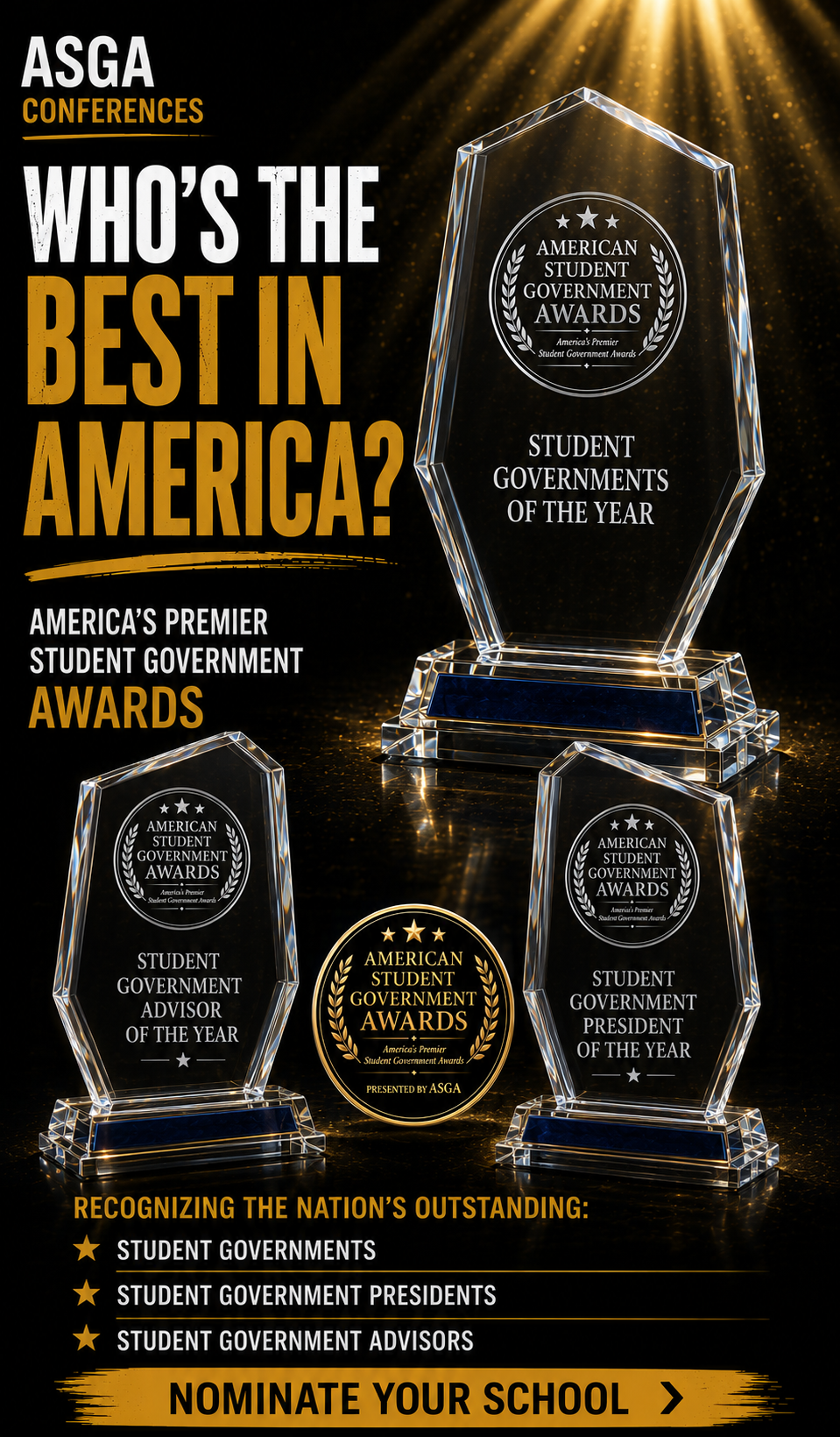
12:00 p.m. to 1:00 p.m. — National SG Summit Awards Luncheon
🏆 Student Government of the Summit Award
🏆 Student Government President of the Summit
🏆 Student Government Advisor of the Summit
Winners must be registered Summit attendees. Nominate your institution by September 24, 2027.
MENU: pasta, salad, dessert, iced tea
Regency B and Regency C/D (Ballroom)
12:45 p.m. to 1:00 p.m. — ASGA Halftime & Raffle
Stamp to Win Raffle Drawing (must be present to win)
Gift cards to Starbucks, Panera Bread, and Subway • Lots more
Regency C/D (Ballroom)
1:00 p.m. to 1:30 p.m. — Networking Break
1:30 p.m. to 2:30 p.m. — Training/Roundtable Block 4
(Tell ASGA what you want to learn about: Take this survey)
-
K No More Drama: Conflict Resolution the “Right Way” – Christopher C. Irving, Ed.D.
Regency B (Ballroom)Conflict in any government is an inevitable consequence when diverse and charismatic leaders come together for a common goal. How these leaders handle those conflicts, however, can determine how effectively the group operates. This workshop is designed to empower SG leaders with practical conflict resolution skills they can use to facilitate difficult conversations, meetings, or events. Attendees will also leave the session having explored their own comfort with conflict as it relates to their SG.
Delivery Format: This workshop utilizes interactive activities that are thought provoking and skills based. Most of the time, participants will feel like they are playing fun and interesting games in this session only to be hit with the “ah ha” moment at the end.
Presentation Resources: This workshop utilizes the participants through interactive experiences.
Level of Interactivity (from 1 to 5, five being very interactive): 5
Learning Outcomes. After attending this session, participants should be able to:
- Gain content knowledge regarding theories & values of conflict, as well as the applicable terminology
- Participate in experiential activities that enhance self-knowledge, team-building and awareness of their SG
- Appreciate the win-win concept and the value it brings to compromise in SG
-
 L How & Why You Must Improve Your SGA’s Web & Social Media Presence – Butch Oxendine
Regency C/D (Ballroom)The times we live in have exposed a major weakness for most Student Governments: our web sites are outdated, inaccurate, and just plain bad. Also, our social networks are drastically underutilized. This workshop will provide tangible instructions on how to improve our entire web presence.
Presentation Resources: This session utilizes the internet.
Level of Interactivity (from 1 to 5, five being very interactive): 4
Learning Outcomes. After attending this session, participants should be able to:
- Understand what should be included at our SG web site
- Learn how to utilize social media to engage our student body
- Recognize the importance of focusing on web/social media
-
M FOR ADVISORS Advising 2.0: Navigating & Negotiating Institutional Politics – Suzette Walden Cole, Ph.D.
Columbia AInstitutional politics does not just affect our students’ abilities to be successful; it can have significant implications for our own career in the field. SG Advisors are often privy to high-level information within the institution by virtue of their work with SG leaders. Our SGs need to trust that we can keep their confidence when they are “floating” ideas, or considering addressing a particular “hot topic.” In this session, we will explore techniques for navigating and negotiating these situations and others.
Delivery Format: Presented in a lecture format. However, the session uses case studies and pair-and-share reflections to unpack experiences with other participants.
Presentation Resources: The session utilizes visual display media and printed handouts.
Level of Interactivity (from 1 to 5, five being very interactive): 4
Learning Outcomes. After attending this session, participants should be able to:
- Gain techniques to establish expectations with colleagues, supervisors and student leaders for information dissemination
- Ability to critically assess situations for potential “political pitfalls”
- Understand how to facilitate successful conflicts between SG leaders and institutional stakeholders
-
N Creating Student Government Advocacy That Effects Change – Andrew Ortiz, J.D.
Columbia BIn this workshop, a former student body president and seasoned government relations professional will share strategies to make your SG’s advocacy efforts more sophisticated and impactful. Participants will receive tangible, real-world tools that their SG can immediately use to create the changes they want to see on campus and in the community.
Delivery Format: Due to the significant amount of technical information provided in this session, it is presented in a lecture format. The presenter welcomes and encourages feedback through direct questions to the audience as well as fielding impromptu questions throughout.
Presentation Resources: The session utilizes visual display media (i.e. Microsoft PowerPoint) as well as printed handouts.
Level of Interactivity (from 1 to 5, five being very interactive): 3
Learning Outcomes. After attending this session, participants should be able to:
- Learn new techniques on how to effectively development your Student Government’s advocacy efforts
- Develop new ideas on how to craft your advocacy messaging
- Learn how to create effective coalitions with other stakeholders to help you to achieve your advocacy goals
-
 O Do the Right Thing: Ethics and Your SGA – Vicky Goodin, Ed.D.
Columbia CWhen it matters, do you do the right thing? Have you ever had a dilemma to resolve in your SGA? What ethical principles does your SGA value? Come understand how developing a code of ethics is as important as setting your yearly goals. This interactive session will help participants gain hands on experience in thinking through ethical dilemmas and developing a code of ethics for their SGA.
Delivery Format: This workshop utilizes a balance of engaging lecture format and interactive small group activities that are self-reflective, thought-provoking and oriented toward skill-building.
Presentation Resources: The session utilizes visual display media (i.e. Microsoft PowerPoint), as well as printed handouts.
Level of Interactivity (from 1 to 5, five being very interactive): 4
Learning Outcomes. After attending this session, participants should be able to:
- Understand the definition of an ethical dilemma
- Learn how to problem solve ethical dilemmas
- Learn how to develop a code of ethical behavior in your SGA
-
Advisor Work/Quiet Space
Bunker Hill - Student Leader Work/Quiet Space
Lexington
2:30 p.m. to 2:45 p.m. — Networking Break
2:45 p.m. to 3:45 p.m. — Training/Roundtable Block 5
(Tell ASGA what you want to learn about: Take this survey)
-
P Hail to the Chief: The Power and Purpose of Being SG President – Christopher C. Irving, Ed.D.
Regency B (Ballroom)This workshop is geared for those who are currently serving or aspiring to become their school’s SG President. The role of President at times can be complicated and intimidating when you are faced with budget, personnel, and administrative challenges. This workshop will equip aspiring Student Government presidents with the skills and tools necessary to manage an effective team, make ethical decisions in financial matters, and work collaboratively with administrators at their institution.
Delivery Format: This workshop utilizes interactive activities that are thought provoking and skills based. Most of the time participants will feel like they are playing fun and interesting games in this session only to be hit with the “ah ha” moment at the end.
Presentation Resources: This workshop utilizes the participants through interactive experiences.
Level of Interactivity (from 1 to 5, five being very interactive): 5
Learning Outcomes. After attending this session, participants should be able to:
- Understand the role and responsibility of the presidency
- Attain skills needed in order to be an effective motivator and inclusionary leader
- Understand the role between the president and administration, and techniques leaders can use to get administrators on board with your agenda
-
Q The 25 Worst Mistakes Your Student Government Can Make (And How to Fix Them) – Butch Oxendine
Regency C/D (Ballroom)Many SGs make the same mistakes over and over, never learning from the past. In this workshop, you’ll discover the most common SG missteps, and most importantly, how to avoid these pitfalls during your term of office.
Delivery Format: Because of the significant amount of information provided in this session, it is presented in a lecture format. The presenter welcomes and encourages feedback through direct questions as well as fielding impromptu questions throughout. The presenter uses volunteers to illustrate key points.
Presentation Resources: The session utilizes Microsoft PowerPoint, as well as printed handouts.
Level of Interactivity (from 1 to 5, five being very interactive): 4
Learning Outcomes. After attending this session, participants should be able to:
- Understand the importance of learning from the mistakes of others
- Brainstorm your own list of mistakes to avoid at your institution
-
R Less Words, More Action: Building Spaces Where Belonging Matters – Suzette Walden Cole, Ph.D.
Columbia A“We want people to feel like they belong.” We say it often, but would the way you or your SGA actually operates prove that it’s true? Belonging isn’t built through one program, celebration, or moment on the calendar. It is shaped by the everyday decisions we make — from who is invited into the conversation to how programs, resources, and opportunities are designed. This session moves beyond good intentions to explore how curiosity, perspective-taking, and intentional decision-making can help create spaces where people can show up authentically rather than simply figuring out how to “fit.” Through reflection and real-world SGA scenarios, participants will leave with practical questions and tangible strategies for making belonging something your SGA does, not just something it says it values.
Delivery Format: This interactive workshop blends engaging discussion, real-world scenarios, reflection, and skill-building designed to move participants from thought to practice.
Presentation Resources: This session utilizes visual display media (e.g., PowerPoint, video) as well as a digital resource.
Level of Interactivity (from 1 to 5, five being very interactive): 4
Learning Outcomes. After attending this session, participants should be able to:
- Recognize how assumptions can influence program planning and decision-making
- Apply perspective-taking to lead effectively across different experiences
- Use self-reflection to build relationships and strengthen collaboration with other students and groups
-
 S Stoke the Fire: Seven Ways to Maximize Your Leadership Potential – Andrew Ortiz, J.D.
Columbia BLeadership is an art and a science, and to become a truly effective leader you must be constantly adding new tools to your toolbox. This workshop will provide you with 7 ways that you can take your leadership to the next level.
Delivery Format: Due to the significant amount of technical information provided in this session, it is presented in a lecture format. The presenter welcomes and encourages feedback through direct questions to the audience as well as fielding impromptu questions throughout.
Presentation Resources: The session utilizes visual display media (i.e. Microsoft PowerPoint) as well as printed handouts.
Level of Interactivity (from 1 to 5, five being very interactive): 3
Learning Outcomes. After attending this session, participants should be able to:
- Learn some effective traits of successful leaders
- Learn ways to positively impact your influence on others
- Understand the breadth and scope of effective leadership and how you can become an even more effective leader
-
T FOR ADVISORS L.E.A.D.: Leadership by Empowering and Appreciating Differences – Vicky Goodin, Ed.D.
Columbia CHave you ever stopped to think about how you lead? Have you ever considered the different voices of those you lead? Developing your leadership style takes time and experience. Let’s dive into understanding your leadership voice as a part of that journey! Do you like to focus on relationships? Are you the type of person who likes to get things done or are you the team strategist? Whatever your style, we all have the ability to lead followers through our authentic voice. Join me as we journey through this topic through an engaging series of questions and experiences.
Delivery Format: This workshop utilizes a balance of engaging lecture format and individual and small group interactive activities that are self-reflective, thought provoking and oriented toward skill building.
Presentation Resources: This session utilizes display media (PowerPoint) as well as printed handouts.
Level of Interactivity (from 1 to 5, five being very interactive): 4
Learning Outcomes. After attending this session, participants should be able to:
- Understand the leadership lens from where they operate
- Understand the 4 Needs of Followers
- Identify how to build trust on a team
-
Advisor Work/Quiet Space
Bunker Hill - Student Leader Work/Quiet Space
Lexington
3:45 p.m. to 4:00 p.m. — Networking Break
4:00 p.m. to 5:00 p.m. — Training/Roundtable Block 6
(Tell ASGA what you want to learn about: Take this survey)
-
U NEW Belonging By Design: Creating an SGA Every Student Can See Themselves In – Kimberly Jones, Ph.D.
Regency B (Ballroom)Having diverse voices in student government is important, but representation alone does not guarantee that students feel like they belong. This interactive workshop challenges student leaders to look beyond who is in the room and examine who feels welcomed, valued, heard, and empowered once they get there. Through realistic SGA scenarios, reflection, and an honest look at their own organizations, participants will explore the everyday leadership practices that can strengthen or weaken belonging.
Delivery Format: This workshop uses individual reflection, facilitated discussion, small-group scenario work, and an organizational audit.
Presentation Resources: This session utilizes visual display media (i.e., Microsoft PowerPoint).
Level of Interactivity (from 1 to 5, five being very interactive): 4
Learning Outcomes. After attending this session, participants should be able to:
- Distinguish between representation and belonging and explain why both matter in student government
- Identify organizational practices and leadership behaviors that can strengthen or create barriers to belonging
- Develop an actionable strategy for creating a more welcoming, inclusive, and participatory SGA culture
-
 V The SG Game Show: How Much Do You Really Know About SG? – Butch Oxendine
Regency C/D (Ballroom)This interactive game show will help you understand the history of SG, trends, firsts, largest budgets, highest voter turnout and more. At the end of the 50-question quiz, you’ll know if you’re an SG expert.
Delivery Format: This workshop is presented as an interactive game-show with attendees as guests.
Presentation Resources: This session utilizes ASGA’s online quiz and handouts.
Level of Interactivity (from 1 to 5, five being very interactive): 5
Learning Outcomes. After attending this session, participants should be able to:
- Understand the history of Student Governments
- Know trends, firsts, mosts, and highest on many SG topics
- Understand where your SG stands compared to other SGs
-
W From Vision to Reality: How to Achieve Your SG Goals – Suzette Walden Cole, Ph.D.
Columbia AIn the higher ed we are being asked to engage in more data-driven decisions and strategies. This makes it essential that SG has done their homework. Upskilling your SG leaders is key to unlocking their success in achieving their goals by anticipating administrators’ questions and stress testing ideas for changes and new ideas. In this session we will explore developing activities for student training and development, use of benchmarking and campus assessment to advance SG advocacy.
Delivery Format: This workshop utilizes a balance of engaging lecture format and interactive activities that are designed for unpack process to practice, thought-provoking and oriented toward skill-building.
Presentation Resources: The session utilizes presentation software, and printed handouts.
Level of Interactivity (from 1 to 5, five being very interactive): 4
Learning Outcomes. After attending this session, participants should be able to:
- Have a basic understanding of how to benchmark and use campus assessment
- Know the steps involved when moving from idea to proposal
- Understand how to present information to be compelling
-
X FOR ADVISORS Leadership Development: Developing the Leaders Within Your SG – Vicky Goodin, Ed.D.
Columbia CThis session includes a brief overview of general leadership development concepts and the importance of helping students develop as student leaders during their tenure in SGA. Often times as advisors and administrators, there is an assumption that our students are prepared for the leadership challenges they face. This session is an interactive, discussion-based lecture on how to identify where a student is developmentally as a student leader and how best to help them acquire the skills they need to continue learning about their leadership abilities through the use of assessments, models, and leadership theory.
Delivery Format: This workshop utilizes a balance of engaging lecture format and interactive activities that are self-reflective, thought-provoking and oriented toward skill-building.
Presentation Resources: The session utilizes visual display media (i.e. Microsoft PowerPoint), as well as printed handouts.
Level of Interactivity (from 1 to 5, five being very interactive): 4
Learning Outcomes. After attending this session, participants should be able to:
- Review current literature on leadership development
- Examine different types of leadership activities that appeal to all types of students
- Learn practical new strategies on leadership development
-
 NEW BONUS SESSION Beyond the Complaint: Turning Student Concerns Into University Action – Isaac Reyna, ERAU SGA President and SGA Officers
Columbia BMany student governments are excellent at identifying problems. Far fewer know how to transform student concerns into realistic, actionable solutions that can gain support from administrators, survive budget constraints, and ultimately improve the student experience.
This workshop introduces a practical Course of Action (COA) framework developed through real student government challenges at Embry-Riddle Aeronautical University. Participants will learn how to move beyond simply advocating for change and instead become effective problem-solvers who can develop, evaluate, and communicate solutions that university leaders can seriously consider.
Using a real-world campus case study, attendees will walk through a structured decision-making process that begins with a student concern and progresses through problem identification, stakeholder analysis, data collection, option development, risk assessment, recommendation formulation, and implementation planning. The session emphasizes collaboration, research, and strategic thinking rather than confrontation or single-solution advocacy.
The second half of the workshop is highly interactive. Participants will work in small groups to address a campus issue, develop multiple courses of action, and adapt their recommendations as new financial, legal, and administrative constraints are introduced. This exercise mirrors the realities faced by student leaders and demonstrates how successful advocacy often requires flexibility, creativity, and compromise.
Whether participants represent a small community college, a large public university, or a private institution, they will leave with
a repeatable framework they can immediately use to tackle challenges on their own campus. -
Advisor Work/Quiet Space
Bunker Hill - Student Leader Work/Quiet Space
Lexington
5:05 p.m. to 5:15 p.m. — Raffle & Ultimate Connectors
Regency C/D (Ballroom)
5:20 p.m. to 6:20 p.m. — Private Consulting
Contact conferences@asgaonline.com to book your one-hour appointment in advance
Lexington
All of these suggested activities are either within walking distance or are convenient via the Metro, taxi, Lyft, or Uber:
- Dinner on the Town: Find out where to eat and see ASGA’s restaurant recommendations and discounts
- Walking Tour of National Mall, Monuments, Museums, The White House, The Capitol
- Dinner and Walking Tour of Union Station
- Theater (The John F. Kennedy Center for the Performing Arts, The Shakespeare Theater, Ford’s Theater)
Also check out “Experience DC.”
▶ Saturday, October 9, 2027
See the meeting room floor plan
8:00 a.m. to 5:30 p.m. — SG Exchange
(Bring your SG brochures, constitutions, & swag to swap with attendees)
Lexington
9:00 a.m. to 10:00 a.m. — Training/Roundtable Block 7
(Tell ASGA what you want to learn about: Take this survey)
-
Y NEW Beyond the Gavel: Building Influence Without a Title – Kimberly Jones, Ph.D.
Regency B (Ballroom)A position may give you authority, but it does not automatically give you influence. Some of the most effective leaders in student government are not the loudest voices or the people with the biggest titles. They are the people others trust, respect, and choose to follow. This interactive workshop explores how student leaders build influence through creditability, relationships, consistency and trust. Through realistic SGA challenges and personal reflection, participants will examine how their everyday leadership behaviors shape their ability to move ideas forward, navigate difficult conversations and make an impact on campus, regardless of the title they hold.
Delivery Format: This workshop uses individual reflection, facilitated discussion, and small-group scenario work.
Presentation Resources: The session utilizes visual display media (i.e. Microsoft PowerPoint)
Level of Interactivity (from 1 to 5, five being very interactive): 4
Learning Outcomes. After attending this session, participants should be able to:
- Distinguish between positional authority and leadership influence
- Identify behaviors that build, damage, and restore credibility and trust
- Develop a strategy for strengthening relationship that increase leadership effectiveness and campus impact
-
 Z NEW How to Build a Better Student Government Election – Butch Oxendine
Regency C/D (Ballroom)A great SG election doesn’t start when voting opens. First find the right students to run. Then you need clear rules, polls students can actually see, and advertising they can’t ignore. Learn how to recruit better candidates, prevent common election problems, create the “Perfect Poll,” and make your election impossible to miss. We’ll also tackle candidate training, debates, inaugurations, and what happens after the votes are counted. Come ready to rethink how your SG runs elections.
Delivery Format: This fast-paced workshop combines practical instruction, audience participation, and interactive exercises. Questions, ideas, and real campus election experiences are encouraged throughout.
Presentation Resources: Microsoft PowerPoint and printed handouts.
Level of Interactivity (from 1 to 5, five being very interactive): 4
Learning Outcomes. After attending this session, participants should be able to:
- Recruit stronger candidates instead of waiting for them to show up
- Prevent common problems that derail SG elections
- Make voting easier to find, easier to understand, and more visible
- Promote an election students actually notice
- Take home specific ideas to improve their next SG election
-
AA Movement Making: Mental Health and Students Rights Advocacy – Kat Klawes
Columbia A83 percent of college students experience a mental health crisis while in college. There are few issues that are of life or death importance on college campuses and mental health supports and policies are one of them. Learn how to evaluate your campus mental health supports and policies. Using interactive activities students will learn how to effectively advocate for better policies.
Presentation Resources: Assessment guide, Prezi, and handouts.
Level of Interactivity (from 1 to 5, five being very interactive): 4
Learning Outcomes. After attending this session, participants should be able to:
- Assess the mental health policies and supports on campus
- Determine which mental health supports or policies can be improved and how to advocate for change effectively
- Know how to implement better mental health policies and create a more inclusive community on their campus
-
BB NEW Just Keep Watching: Reels That Spark Action and Campus Connection – Cheyenne Olson
Columbia BSocial media shouldn’t just capture attention, but inspire action. Just Keep Watching explores how student leaders and students can transform everyday campus moments into reels that stop the scroll, tell compelling stories, and encourage students to get involved. Students will discover what makes audiences keep watching, how to develop content pillars, create stronger hooks, batch content, and turn campus experiences into engaging short-form video. Through real examples, students will leave with strategies for creating consistent, authentic content that celebrates student life, strengthens campus connection, and moves students from simply watching to attending, joining, sharing, and engaging.
Learning Outcomes. After attending this session, participants should be able to:
- Identify the key elements of scroll-stopping Reels, including strong hooks, relatability, emotion, curiosity, storytelling, and calls to action
- Develop strategic content pillars that create consistency while showcasing campus life, student leadership, events, and authentic student experiences
- Create a Reel concept using a clear hook, storyline, content pillar, and call to action designed to encourage student involvement
- Apply content planning and batch-filming strategies to efficiently produce consistent social media content that strengthens campus connection and inspires action.
-
CC NEW Dealing with Hateful, Offensive, and Controversial Speech: How Student Leaders Can Address Free Speech Issues on Campus – Gabe Walters, Foundation for Individual Rights and Expression (FIRE)
Columbia CStudent government representatives often confront questions of how to respond to controversial speech. An unpopular student group seeks official recognition. A controversial group or speaker seeks access to public spaces on campus. What does campus free speech look like? Why is defending free speech important? And how can student leaders address free speech controversies in a principled way?
Delivery Format: This interactive workshop gives participants a broad understanding of First Amendment law and principles as it pertains to college campuses. It draws from real-world examples and encourages audience participation.
Presentation Resources: Microsoft Powerpoint and printed handouts.
Level of Interactivity (from 1 to 5, five being very interactive): 4
Learning Outcomes. After attending this session, participants should be able to:
- Identify the First Amendment and how it pertains to college campuses
- Identify examples of free speech on campus
- Consider the importance of the freedom of speech on campus and in society
- Understand what categories of speech are unprotected by the First Amendment
- Consider offensive speech or “hate speech” and how to respond to it as campus leaders when it arises
-
Advisor Work/Quiet Space
Bunker Hill - Student Leader Work/Quiet Space
Lexington
10:00 a.m. to 10:15 a.m. — Networking Break
10:15 a.m. to 11:15 a.m. — Training/Roundtable Block 8
(Tell ASGA what you want to learn about: Take this survey)
-
DD NEW Don’t Just Recruit Them, Develop Them – Kimberly Jones, Ph.D.
Regency B (Ballroom)Strong SGAs do not just recruit members. They develop them. This interactive workshop gives SGA officers and executive board members practical strategies for preparing their teams to lead, work together, and stay engaged throughout the year. Participants will explore how to create meaningful retreats, leadership workshops, team-building activities, icebreakers, and ongoing development opportunities that go beyond simply having fun and actually strengthen the organization. Whether your SGA has a formal training program or is figuring it out as you go, you will leave with activities, ideas, and a framework you can take back to your campus and use to intentionally develop your members.
Delivery Format: This workshop uses hands-on activities, small-group discussion, and leadership development planning.
Presentation Resources: The session utilizes visual display media (i.e., Microsoft Power Point).
Level of Interactivity (from 1 to 5, five being very interactive): 4
Learning Outcomes. After attending this session, participants should be able to:
- Identify the key elements of an effective SGA retreat or leadership development experience
- Explore practical icebreakers, team-building activities, and mini-workshops that strengthen communication, trust, collaboration, and leadership skills
- Develop strategies for providing ongoing leadership development to SGA members throughout the year
-
EE How to Make Students Care About Your Student Government – Butch Oxendine
Regency C/D (Ballroom)Your SG must do something real that matters to fellow students if you ever want to be respected and appreciated. This workshop will give real examples of innovative and exciting “signature programs” that are being used by SGs nationwide to get the attention of students and administrators. These programs will make your SG much-admired and “relevant,” and will help you with everything from member recruiting to voter turnout to relations with administrators.
Delivery Format: Because of the significant amount of information provided, it is presented in a lecture format. The presenter welcomes and encourages feedback through direct questions as well as fielding impromptu questions throughout.
Presentation Resources: The session utilizes Microsoft PowerPoint, printed handouts, and props.
Level of Interactivity (from 1 to 5, five being very interactive): 4
Learning Outcomes. After attending this session, participants should be able to:
- Be aware of the 800 programs you could bring to your campus
- Understand what makes a “signature program” and how you find one that will work for you
- Understand which signature programs are best
-
FF Spark Sessions: Innovation Lab – Kat Klawes
Columbia AWelcome to Spark Sessions, where ideas ignite and action takes center stage. In these interactive, hands-on innovation labs, student leaders collaborate in real time to transform inspiring concepts into impactful campus initiatives. Guided by a seasoned student leader and policy consultant, participants engage in rapid brainstorming, structured ideation, and practical planning exercises. This session emphasizes creativity, collaboration, and strategic thinking, ensuring every participant leaves with a clear, actionable plan for immediate implementation.
Presentation Resources: Interactive group brainstorming, guided planning templates, and facilitator-led rapid brainstorming activities.
Level of Interactivity (from 1 to 5, five being very interactive): 5
Learning Outcomes. After attending this session, participants should be able to:
- Rapidly generate and refine innovative ideas for campus initiatives
- Master structured techniques for assessing idea feasibility and potential impact
- Enhance collaborative skills by working dynamically with peer leaders
- Identify common roadblocks and develop preemptive solutions
-
GG The Power of Committees: Turning Ideas Into Action – Mickey Arce
Columbia BEver feel like your Student Government spends more time talking than doing? Committees are the secret weapon that can turn ideas into real results. By allowing student leaders to focus on specific issues, delegate responsibilities, and involve more voices in decision-making, committees make action possible. Drawing on experience from both two-year and four-year Student Government institutions, this workshop will share best practices for structuring committees, keeping members motivated, and ensuring their work translates into meaningful change on campus.
Delivery Format: This workshop begins with a brief lecture followed by a series of interactive exercises and group work.
Presentation Resources: The session utilizes visual display media (i.e. Microsoft PowerPoint).
Level of Interactivity (from 1 to 5, five being very interactive): 4
Learning Outcomes. After attending this session, participants should be able to:
- Explain the role of committees in making Student Government more effective and action oriented
- Recognize the impact committees can have on students
-
HH Administrators are NOT the Enemy: How to Get Along With Yours – Christopher Jachimowicz
Columbia CSG-friendly administrations are easy to spot. They’re easy to talk to, treat student leaders as peers in the governance process, respect the SG’s autonomy, and value SG’s input on key institutional decisions. This useful workshop, which is a companion to the “SG Effectiveness Test,” identifies the top 10 characteristics that make for an SG-friendly administration. Through ASGA’s exclusive “Administrator Test,” you’ll decide how well your administration meets these ideals and give it a score. Then you’ll know if it’s time to thank your administration for their assistance—or if you should take time to build a better relationship.
Delivery Format: The facilitator provides context for the 10 characteristics and invites participants to share experiences from their own campuses. The session is largely lecture format with the opportunity for both formal and informal question and answer.
Presentation Resources: The session utilizes visual display media (i.e. Microsoft PowerPoint, Apple Keynote) as well as printed handouts.
Level of Interactivity (from 1 to 5, five being very interactive): 3
Learning Outcomes. After attending this session, participants should be able to:
- Consider the perspective of administrators in relationship to the SG
- Form new behaviors to develop a better long-term relationship with administration
- Implement additional surveys to better assess the relationship with administration
-
Advisor Work/Quiet Space
Bunker Hill - Student Leader Work/Quiet Space
Lexington
11:15 a.m. to 11:30 a.m. — Networking Break
11:30 a.m. to 12:30 p.m. — Training/Roundtable Block 9
(Tell ASGA what you want to learn about: Take this survey)
-
II NEW FOR ADVISORS The Goal Is to Need You Less – Kimberly Jones, Ph.D.
Regency B (Ballroom)SGA advisors constantly navigate a difficult balance: when do you step in, and when do you step back? Supporting student leaders does not mean solving every problem, preventing every mistake, or having every answer. Sometimes the most powerful thing an advisor can do is ask the right question and allow students to lead. This interactive workshop explores the shift from traditional advising toward a leadership-coaching mindset. Through realistic advising dilemmas, reflection, and practical strategies, participants will examine when they may be unintentionally taking ownership away from students and learn approaches that build confidence, accountability, decision-making, and independence.
Delivery Format: This workshop uses individual reflection, facilitated discussion, and small-group scenario work.
Presentation Resources: The session utilizes visual display media (i.e., Microsoft PowerPoint).
Level of Interactivity (from 1 to 5, five being very interactive): 4
Learning Outcomes. After attending this session, participants should be able to:
- Distinguish between advising, directing, and coaching student leaders
- Identify situations in which stepping back can increase student ownership, confidence, and accountability
- Apply coaching questions and strategies that help student leaders solve problems and make decisions independently
-
JJ What Are Your Superpowers? What Your SGA Can (And Can’t) Do – Butch Oxendine
Regency C/D (Ballroom)We all like to think our SG can change the world, but the reality is more brutal. Even the greatest SGs in America are limited in their authority, “power,” and influence. Can you really stop tuition increases, get more financial aid from the federal government, and build a new parking garage? This brutally frank session tells the truth about which projects, issues, and programs you can take on successfully—and which ones are doomed to fail.
Delivery Format: Because of the significant amount of information provided in this session, it is presented in a lecture format. However, half of the workshop is an interactive exercise that includes all participants working in small groups. The presenter welcomes and encourages feedback through direct questions as well as fielding impromptu questions throughout.
Presentation Resources: The session utilizes Microsoft PowerPoint, as well as printed handouts.
Level of Interactivity (from 1 to 5, five being very interactive): 4
Learning Outcomes. After attending this session, participants should be able to:
- Understand which issues are impossible, possible, and probable to make a difference
- Understand how to prioritize your work on issues that are realistic
- Determine how much time to spend on lobbying
-
KK Money Matters: Managing Budgets and Funding Student Activities – Kat Klawes
Columbia AStudent government treasurers and finance leaders play a crucial role in enabling student activities, events, and initiatives. Effectively managing and allocating funds requires strategic planning, clear processes, and transparency. Join this session, led by a Certified Nonprofit Accounting Professional (CNAP), former Student Government President, and higher education consultant, to master essential financial leadership skills. Learn how to create and manage clear budgets, responsibly allocate resources, secure additional funding, and communicate financial decisions transparently to the student body and campus community.
Presentation Resources: Interactive budgeting exercises, scenario-based simulations, and group discussions.
Level of Interactivity (from 1 to 5, five being very interactive): 4
Learning Outcomes. After attending this session, participants should be able to:
- Develop and maintain transparent, sustainable budgets for Student Government
- Create effective and equitable funding allocation processes
- Identify and pursue additional funding opportunities, including fundraising strategies
- Clearly and effectively communicate financial decisions and updates to students and campus stakeholders
- Evaluate financial activities to align spending with the organization’s mission and goals
-
LL NEW Align, Empower, Sustain (Student Organization Development) – Brandy Stephens, LeaderShape
Columbia BAlign, Empower, Sustain is a curriculum designed to re-invigorate student organizations from the ground up – first exploring the mission consistency of organizations, then focusing on member engagement strategies, and then end with long-term culture creation. Receive proven strategies for your student government and/or your student organizations.
Presentation Resources: Interactive activities connected to expectations and strategy, scenario-based reflections, group discussions and information on accessing entire curriculum for use on your campus.
Level of Interactivity (from 1 to 5, five being very interactive): 4
Learning Outcomes. After attending this session, participants should be able to:
- Understand the role of mission statements in organizations
- Assess the presence of empowerment in their organization
- Engage in possibility leadership to create greater organizational empowerment
-
MM Reviewing Your Governing Documents for Clarity and Purpose – Christopher Jachimowicz
Columbia CGoverning documents are the foundation of every legitimate organization. But how do you know if yours are good enough? This session provides a framework for evaluating the strength and effectiveness of your organization’s constitution using the basic principles of a deliberative assembly outlined in Robert’s Rules of Order Newly Revised.
Delivery Format: Due to the significant amount of technical information provided in this session, it is presented in a lecture format. The presenter welcomes and encourages feedback through direct questions to the audience as well as fielding impromptu questions throughout.
Presentation Resources: The session utilizes visual display media (i.e. Microsoft PowerPoint, Apple Keynote) as well as printed handouts.
Level of Interactivity (from 1 to 5, five being very interactive): 3
Learning Outcomes. After attending this session, participants should be able to:
- Identify components belonging in a constitution or bylaws
- Restate the “Four Keys to Document Review”
- Evaluate the appropriateness of certain words and language
- Question the effectiveness of current structures in representing students
-
Advisor Work/Quiet Space
Bunker Hill - Student Leader Work/Quiet Space
Lexington
12:30 p.m. to 1:00 p.m. — Boxed Lunch
Lexington
1:00 p.m. to 1:15 p.m. — Raffle & Ultimate Connectors
Regency C/D
1:15 p.m. to 2:15 p.m. — Training/Roundtable Block 10
- Presidents & Vice Presidents (Kimberly Jones, Ph.D., facilitator)
Regency B (Ballroom) - Senators, Representatives, Judicial Branch, and Committee Members (Butch Oxendine, facilitator)
Regency C/D (Ballroom) - Secretaries and Treasurers (Kat Klawes, facilitator)
Columbia A - Advisors (Christopher Jachimowicz, facilitator)
Columbia B
1:30 p.m. to 4:30 p.m. — (OPTIONAL ACTIVITIES)
Contact conferences@asgaonline.com to book your one-hour appointment in advance
- 1:30 p.m. to 2:30 p.m. — Private Consulting
Lexington - 2:30 p.m. to 3:30 p.m. — Private Consulting
Lexington - 3:30 p.m. to 4:30 p.m. — Private Consulting
Lexington - Visits to monuments and museums (on your own)
All of these suggested activities are either within walking distance or are convenient via the Metro, taxi, Lyft, or Uber:
- Dinner on the Town: Find out where to eat and see ASGA’s restaurant recommendations and discounts
- Walking Tour of National Mall, Monuments, Museums, The White House, The Capitol
- Dinner and Walking Tour of Union Station
- Theater (The John F. Kennedy Center for the Performing Arts, The Shakespeare Theater, Ford’s Theater)
Also check out “Experience DC.”
▶ Sunday, October 10, 2027
Conference Attire • Sunday — College/University Shirts & Jeans
See the meeting room floor plan
7:30 a.m. to 8:00 a.m. — (OPTIONAL) Non-denominational Worship/Prayer
Lexington
8:00 a.m. to 12:00 p.m. — SG Exchange
(Bring your SG brochures, constitutions, & swag to swap with attendees)
Lexington
8:30 a.m. to 9:00 a.m. — Networking Break
9:00 a.m. to 10:00 a.m. — Training/Roundtable Block 11
(Tell ASGA what you want to learn about: Take this survey)
-
NN NEW From Complaints to Change: Turning Student Concerns into Action – Lexie Bumah and Gabriel Fisher, Marymount University
Regency C/D (Ballroom)Every student government faces campus concerns, but how do you turn those complaints into real change? In this interactive workshop, participants will take on common campus challenges involving dining, transportation, amenities, and more through an activity called “Campus Chaos.” Learn how to identify student concerns, develop effective solutions, and advocate for your student body at every level of university leadership. We’ll share our own experience addressing shuttle service concerns at Marymount University, including how we brought the issue directly to our university’s cabinet to work toward a solution. Come ready to tackle real campus challenges, discover the power of your voice, and learn how to turn student concerns into meaningful action.
Delivery Format: This interactive workshop combines hands-on group activities, practical instruction, real campus experiences, and group discussions. Participants will work together to solve hypothetical campus crises, learn from real-world examples, and explore effective ways to advocate for their student body.
Presentation Resources: Microsoft PowerPoint and printed handouts, including a campus concern resolution template for participants to take back to their respective institutions.
Level of Interactivity (from 1 to 5, five being very interactive): 4
Learning Outcomes. After attending this session, participants should be able to:
- Identify common campus concerns and develop practical solutions to address them
- Effectively communicate student concerns to university administration and leadership
- Understand how to advocate for their student body, even when concerns must be addressed at the highest levels of university leadership
- Turn student complaints into actionable plans that lead to meaningful campus improvements
- Take home a practical template to help address student concerns and advocate for change at their own institutions
-
OO Magnus Principles: I am, You Are, We Are Magnus! #Greatness – Michael A. Cadore Sr., Ed.D.
Regency B (Ballroom)This discussion opens a dialogue to discuss principles to success! By participating in the Magnus Principles: I am, You Are, We Are Magnus! #Greatness workshop, you’ll gain skills needed to create major breakthroughs in the achievement of your goals and the quality of your life professionally and personally. Preparation, Patience, Professionalism, Pride, Persistence, Praise.
Delivery Format: This 60-minute discussion allows attendees to share experiences, and discuss effective ways to promote, engage and achieve student success through interaction, sharing of personal and professional experiences.
Presentation Resources: PowerPoint.
Level of Interactivity (from 1 to 5, five being very interactive): 5
Learning Outcomes. After attending this session, participants should be able to:
- Understand the importance of Magnus Principles
-
PP SG 101: Getting Student Feedback, How & Why – Kat Klawes
Columbia AStudent Government’s job is to represent students on their campus. A crucial part of representing students is to know student opinions. Hear from a former SG President and professional advocate on how to solicit feedback and involvement from the student body. Learn how to effectively collect student feedback, about assessing student feedback, and how to create systems that help engage students within Student Government.
Learning Outcomes. After attending this session, participants should be able to:
- Understand how to use student feedback effectively
- Assess the student feedback collection methods for their SG
- Know how to utilize tools to better collect student feedback
- Learn how to actively engage students on their campus
10:00 a.m. to 10:15 a.m. — Networking Break
10:15 a.m. to 11:15 a.m. — Training/Roundtable Block 12
(Tell ASGA what you want to learn about: Take this survey)
-
QQ NEW From Idea to Completion: A Four-Step Process for Student Government Initiatives – Daniel Haien, Undergraduate Student Body President, Colorado School of Mines
Regency C/D (Ballroom)Many Student Government initiatives begin with a great idea, but can become unrealistic, stuck in endless discussion, lost in administrative red tape, unwanted by students, and end up failing to deliver any notable impact. Through a four-step initiative process (Idea, Explore, Legislate, Complete), this session will reveal effective practices for gathering student feedback and relevant information, engaging the appropriate campus partners, moving an idea through your legislature, and executing follow-through without losing perspective, momentum and student support. Participants will learn how to successfully navigate an initiative from an initial idea all the way through to long term, sustainable change at their institutions, and practice applying the four-step initiative process to real-life scenarios.
Delivery Format: This session is presented in a lecture format followed by small group work, then large-group discussion.
Presentation Resources: This session utilizes a Microsoft PowerPoint slide deck and printed handouts.
Level of Interactivity (from 1 to 5, five being very interactive): 4
Learning Outcomes. After attending this session, participants should be able to:
- Navigate a formal four-step initiative process guided by student input
- Conduct excellent research into the root causes of student feedback and identify solutions
- Question and discuss an initiative with the appropriate university officials
- Draft clear, actionable legislation and follow-through on it
-
RR Student Government is a Bunch of C.R.A.P. (Communication-Respect-Attitude-Professionalism) – Michael A. Cadore Sr., Ed.D.
Regency B (Ballroom)To provide insight, discussion and direction that will lead to and/or maintain effective Student Government Associations. This is accomplished through positive Communication, Respect & Relationships, Attitude & Awareness, and Professionalism & Policy procedures.
Delivery Format: This 60-minute interactive workshop breaks the room into two groups that compete, share experiences, and participate through discussion effective ways to succeed as a Student Government association. This is a fun music activated lecture. The presenter encourages feedback through direct questions/demonstrations throughout.
Presentation Resources: PowerPoint; handouts.
Level of Interactivity (from 1 to 5, five being very interactive): 5
Learning Outcomes. After attending this session, participants should be able to:
- Understand the importance of Positive Communication, Respect, Attitude and Professionalism as it pertains to your role with Student Government
- Learn six principles to success steps as a student and/or Student Government
-
 SS Ten Toxic Timewasters (That Poison Productive Meetings) – Christopher Jachimowicz
Columbia AYou’re short on time. You want to get into the SG meeting, get the business done, and get onto your next responsibility. You get to the meeting and it seems as if time is standing still. Why do these meetings take so long and what can be done to make them not only shorter, but more effective? This session uncovers ten common but unnecessary practices that make meetings longer than they need to be.
Delivery Format: Due to the significant amount of technical information provided in this session, it is presented in a lecture format. The presenter welcomes and encourages feedback through direct questions to the audience as well as fielding impromptu questions throughout.
Presentation Resources: The session utilizes visual display media (i.e. Microsoft PowerPoint, Apple Keynote) as well as printed handouts.
Level of Interactivity (from 1 to 5, five being very interactive): 3
Learning Outcomes. After attending this session, participants should be able to:
- Identify practices within their own meetings that waste time
- Explain more appropriate practices to expedite meetings
- Participate with greater confidence in organizational meetings
11:15 a.m. to 11:20 a.m. — Break
11:20 a.m. to 11:45 a.m. — Summit Finale & Raffle
- Michael A. Cadore Sr., Ed.D., Emcee
- Ultimate Connectors Raffle (return your evaluation form to enter)
Gift cards to Darden (Red Lobster, Longhorn Steakhouse & 4 others) and Raising Cane’s • Lots more - Completion of Training Certificates
- “Attend. Learn. Implement. Improve. Repeat” – Butch Oxendine
Regency C/D (Ballroom)
12:00 p.m. to 3:00 p.m. — (OPTIONAL ACTIVITIES)
Check out “Experience DC” for ideas on sight-seeing and restaurants
▶ Monday, October 11, 2027
Lobbying on Capitol Hill (OPTIONAL)
- Visits to U.S. House of Representatives members and U.S. Senators (on your own)
- Visits to monuments and museums (on your own)
Conference Materials

Recently registered for the
2026 National
Student Government Summit